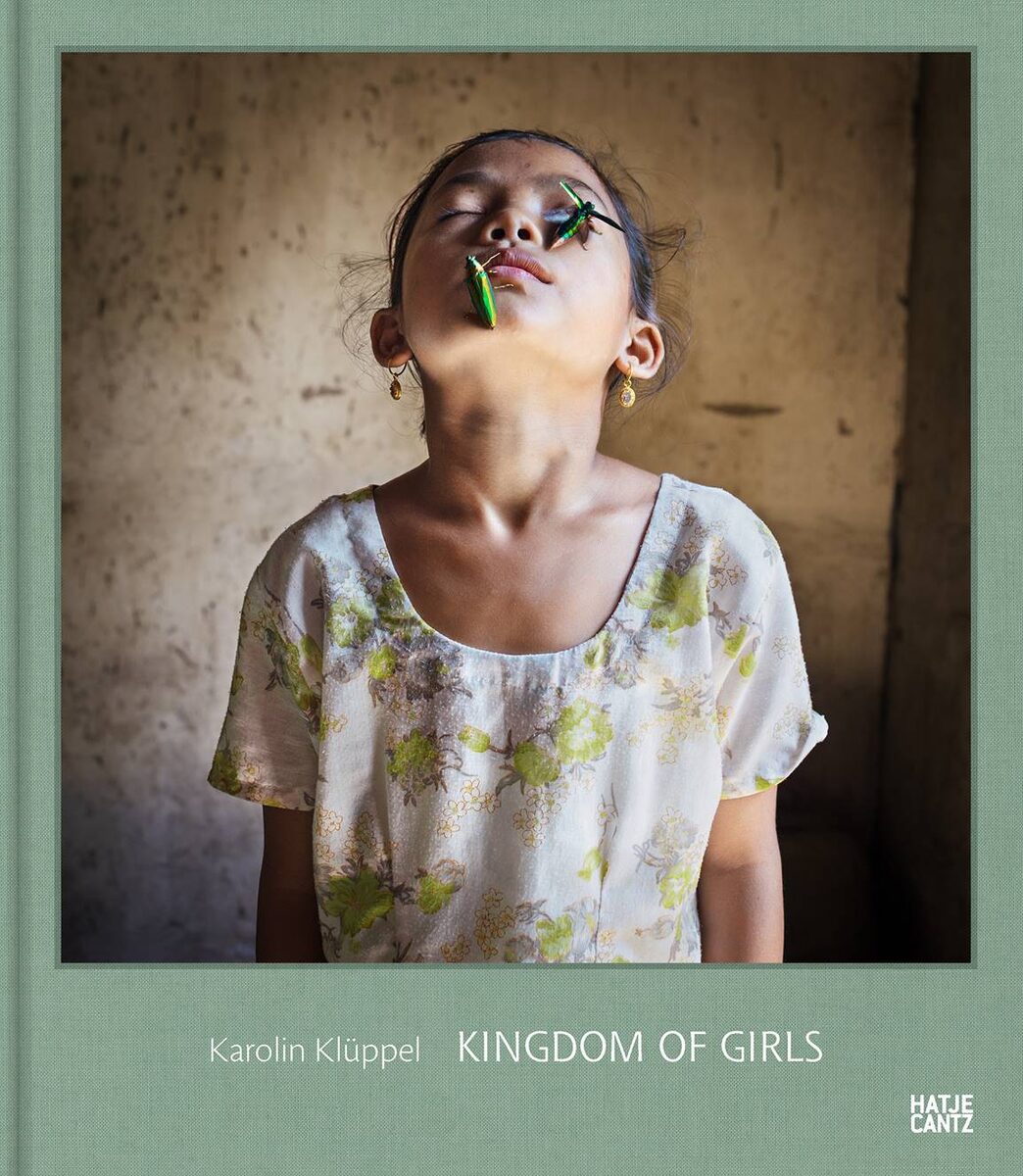
Welcome to Kingdom of Girls: Most precious in a Khasi family are its girls – they pass the name, take care of the parents and manage the family wealth and property. Young photographer Karolin Klüppel went on a journey to the far north-east of India and created an impressive portrait of the Khasi, one of the few matrilineal ethnic groups worldwide. Her publication "Mädchenland" reflects the world of women growing up in this social form, revealing a still largely unknown side of the Indian subcontinent.
In the state of Meghalaya in India, located in the north-eastern most part of the country, the indigenous people of the Khasi with 1.1 million members form the majority of the population. The Khasi are a matrilineal society. Here, traditionally it is the girls who are of particularly importance and who play an exposed role in the family: The Khasi are a matrilineal society. The line of succession passes through the youngest daughter, or Khadduh. If she marries, her husband is taken into her family's house, and the children take their mother's name. This comes with special responsibilities. They are expected to care for their parents and keep their house open for support to everyone within the clan. This kind of culture, which is built entirely on female needs, guarantees girls and women in Meghalaya an economic and social independence which is unique in India.
The village is considered the cleanest village throughout India and is also referred to as "God's own garden". It is where Karolin Klüppel had the honor of getting to know the culture of the Khasi. The photographer spent several months among the 500 inhabitants and joined in everyday life of the families. She captured her visit in her photos. Spanning an arch between documentation and production, her photos are marked by a keen sensitivity for composition. Similar to how a director works, Küppel transformed the underlying concept of each motif step by step and tells a story about the life of the Khasi with each photo. The girls enjoyed working with her - who not always let the German photographer have all the fun finding the idea: "Whenever I met with the girls, they wanted me to take a picture right away. Sometimes they allowed me to stage their portrait and design a stage for them. Often, however, they were also the ones who directed me so that I would take the photo exactly how they wanted it," Karolin Klüppel describes her work.
The result is a portrait of a still largely unknown side of widely patriarchal India. The publication "Mädchenland", or Kingdom of Girls, is a compilation of 36 works from the series in an artist's book. The focus is on the portraits of the adolescent girls in their everyday surroundings: One girl sits on a kitchen cabinet next to a plastic basket filled with fruit, another is wrapped in a splendid shiny Sunday dress holding a live rooster in her arms, while yet another has metallic bugs crawling on her face. The young girls always look natural. They play, move and dress up, as if there were no camera is site. And yet the color-intensive shots have nothing playful. Instead, they seem to anticipate that one day the girls will have to take a lot of responsibility – and they have already started to do so.
"These children have to take a lot of responsibility already at a very young age. Even before the age of eight, they do the household and take care of younger siblings," Karolin Klüppel tells us. "This may appear at first like an end to their childhood, but I have never met happier and more self-conscious girls than in Mawlynnong."
The men in the village work six days a week, mainly on the fields and, as tradition has it, remain penniless. Most of them are filled with great pride just for belonging to the unique culture. But the Khasi men feel increasingly disenfranchised, and many are alcoholics or drug addicts. "I met happy mothers, self-confident daughters, and proud fathers, but also learned what conflicts can arise in a society where men do not have the same rights as women. This is where the Khasi resemble other communities with inequality in the distribution of rights," the photographer describes her experiences in the Indian jungle. Social problems, however, are deliberately not included by Klüppel in her photo project. She did not want to analyze but instead observe, and by doing so, grant extraordinarily sensitive insight into the Kingdom of Girls with a great deal of empathy.
Karolin Klüppel has received several awards for her work including the Canon Profifoto Award 2014 and the Felix Schoeller Award in 2015. Her work has been on display in renowned international magazines such as The National Geographic Magazine, The New York Times, The Independent, The Huffington Post as well as in The Washington Post.
KAROLIN KLÜPPEL MÄDCHENLAND | KINGDOM OF GIRLS . Publisher. Karolin Klüppel, texts by Andrea Jeska, Karolin Klüppel, designed by Hannah Feldmeier . German, English 2016. 92 pages, 38 color ills. 23.00 x 26.00 cm hardcover, bound . ISBN 978-3-7757-4206-1 . 34 € hatjecantz.de