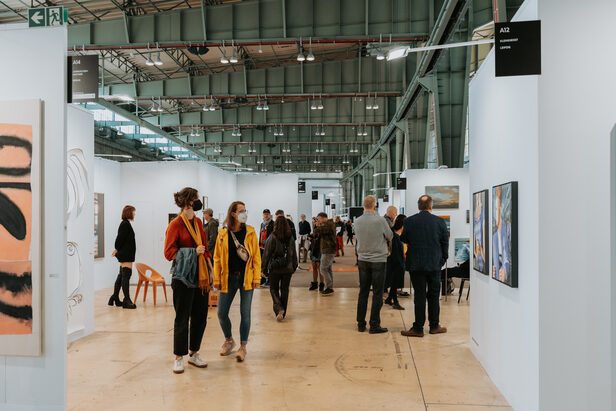
'Oh Glorious Sun of Rainbow Afro Wigs' - the work of the late Mike Kelley drew visitors magically to booth of the David Zwirner Gallery at ART COLOGNE. Once again, the New York gallery was in the Rhineland to meet old and new collectors or those interested in art. Purchasing something at Zwirner costs a pretty penny. There are only Big Names such as Neo Rauch, Thomas Ruff or Martin Kippenberger hanging on the walls or as statues such as Iza Genzken's Cowboy in front of the booth. The modern 'Nature Mort' by Wolfgang Tillmans was the center piece of the booth but was sold so fast, we didn't even have the chance to take a picture for you...
GoSee met Veronique Ansorge, now Director at Zwirner Gallery New York, at the gallery's booth at ART COLOGNE. And, of course, in our favorite hotel in Cologne: marsil. We present our short film from the fair for the book launch of Cologne/New York 1984–1989 with work by Raymond Pettibon and others mentioned above for you here on GoSee.
We also have the press release with interesting facts: "In the words of Peter Schjeldahl, writing in The New Yorker about the 2014 exhibition No Problem: Cologne / New York 1984–1989 at David Zwirner in New York, “the show’s cast of artists amounts to a retrospective shopping list of what would matter and endure in art of the era.” With an eye to canonizing that moment, this seminal publication examines the latter half of the 1980s through the lens of international art scenes that were based in Cologne — arguably the European center of the contemporary art world at that time — and New York.
While a number of established Cologne-based gallerists, including Karsten Greve, Paul Maenz, Rolf Ricke, Michael Werner, and Rudolf Zwirner, had already begun shaping the European reception of American art in the previous decade, the 1980s marked a period during which art being produced in and around Cologne gained international attention. A burgeoning gallery scene supported the emerging work of artists based in the region, with gallerists such as Gisela Capitain, Rafael Jablonka, Max Hetzler, and Monika Sprüth showing artists such as Walter Dahn, Martin Kippenberger, Albert Oehlen, Rosemarie Trockel, and others. The works of these German artists were exhibited along with the latest contemporary art from the US by artists like Robert Gober, Jeff Koons, Richard Prince, Cindy Sherman, and Christopher Wool. Conversely, the works of German artists were presented in New York, with breakout exhibitions at galleries such as Barbara Gladstone, Metro Pictures, Luhring, Augustine & Hodes, and other significant venues. Important museum exhibitions that explored work being produced and exhibited on both sides of the Atlantic also set the tone for this ongoing dialogue, among them Europa / Amerika (Museum Ludwig, Cologne, 1986) and A Distanced View: One Aspect of Recent Art from Belgium, France, Germany, and Holland (New Museum, New York, 1986).
Big, bold, and vibrant, this Pentagram-designed publication revives the conversation, reproducing in full color over one hundred immensely varied artworks by the twenty-two international artists included in this massive exhibition — one of the largest in David Zwirner’s history. Beyond its stunning visual components, the book features crucial new scholarship by Diedrich Diederichsen and Bob Nickas, and an illustrated chronology of the decade by Kara Carmack. The book also includes an arsenal of compelling archival material, from documentary photographs from the period to reproductions of Cologne’s culture magazine Spex. Taken as a whole, this ambitious exhibition catalogue encapsulates the energy, heart, and “dissonance of styles” — in the words of Schjeldahl — embodied by this fascinating and fecund moment in global art history.
Artists featured in the book include Werner Büttner, George Condo, Walter Dahn, Jiri Georg Dokoupil, Peter Fischli/David Weiss, Günther Förg, Robert Gober, Georg Herold, Jenny Holzer, Mike Kelley, Martin Kippenberger, Jeff Koons, Barbara Kruger, Sherrie Levine, Albert Oehlen, Raymond Pettibon, Richard Prince, Cindy Sherman, Rosemarie Trockel, Franz West, and Christopher Wool.
No Problem: Cologne/New York 1984–1989 . Foreword by David Zwirner. Texts by Diedrich Diederichsen and Bob Nickas. Illustrated chronology by Kara Carmack . The book is available online at: David Zwirner Books, Price: $65.00 . www.davidzwirnerbooks.com
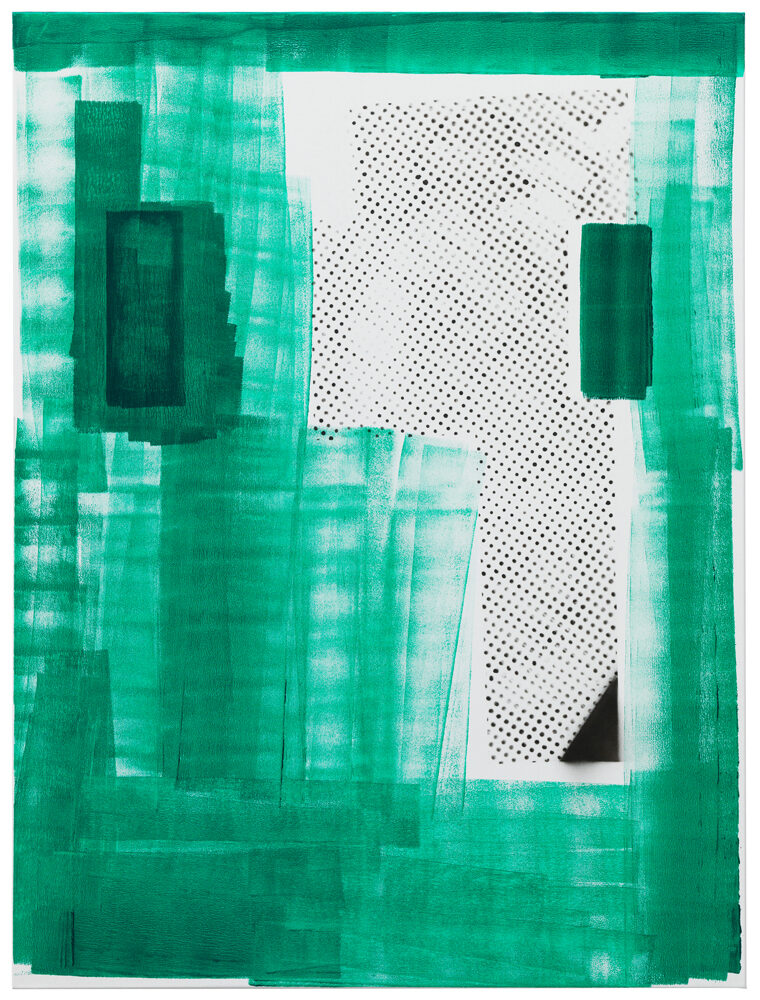
In 2015, the Society for Contemporary Art at the Museum Ludwig e. V. give the Wolfgang-Hahn prize to two artists: Michael Krebber and RH Quaytman. As a part of the award ceremony, there is a joint exhibition at the Museum Ludwig, which is open through 30 August, 2015, with a central focus on subject of the impossibility of painting. "For many years, both artists have been working on the premises, challenges and opportunities of contemporary painting and have made unique contributions on this issue," said Yilmaz Dziewior who was a member of the jury as designated Director of the Museum Ludwig.
Preparing for an interview with Michael Krebber as an artist, you find the strangest stories on the Net. He has allegedly burnt pictures, eaten glass, marketed his daily visits to a gallery in Cologne as performance art, and has generally put everything and the world in question. "A lot of it is true, some of it, I don't even remember myself," Michael tells us in the lobby of our hotel marsil in Cologne. He was born in Cologne and lived there until the mid-70s, then again from 1984. Since 2002, he has taught at the Städel School in Frankfurt. Here's a little game of 20 questions for you on GoSee:
We just read in an article about you: "Painting is a great hobby, I even consider myself competent". Is that true or is this quote fake? I actually said that. It means that I work in a discipline that I take seriously, but, depending on how you look at it, its significance changes. And that also applies to the occupation. I wanted to distance myself.
In your artist book "Alien Hermaphrodites" You write that you can really only can put quotes around the art form painting. What exactly do you mean? I wanted to address the different meanings or programs that the word can have in a given situation, especially for different people with different ideas. In a conversation but also in a monologue their are mixed complications, and you could then circumvent the term "painting" with a placeholder and say painting and insert any of these possible meanings. There is much ambiguity.
How important is humor in art? I would separate humor from the humorous, for example, if someone trys to make an audience smile or succeeds in doing so, it can be quite unbearable, unless it's done by a grandmaster, who has a quick way with ambiguity.
Is art still as funny as it was when you started back in the eighties? Yes.
What went through your mind when you heard that you were to be this year's winner of the Wolfgang Hahn Prize? I was completely taken by surprise and was really pleased. I never thought that I would be offered anything.
And that the prize was to be awarded to two artists for the first time and you would have to share it with R.H. Quaytman? That was all part of the surprise and the joy. I do not see as "having to share" it, it just makes the whole process much more enjoyable, and I'm friends with Rebecca Quaytman for several years and we know each other very well I think.
Is your name now linked forever with her's? That's a funny question. I would say Yes! Forever! And hanging an exhibition together with Rebecca Quaytman was a good thing to do - and I had not expected otherwise.
We are delighted that you're staying at Marsil with us while preparing the exhibition. You celebrated your 50th birthday a few years ago at our hotel. Should we not give the press some new and fabulous stories now and create new legends? The birthday was a present organized by Cosima von Bonin, and it was a fabulous story! There are no photos of it. If anyone has any, please send them to me at the marsil address!
The celebration began in Cosima von Bonin's atelier with a huge buffet created by Almut Middel, no photos of that either! There were cherries made of meat sausage and surely 20, 30 plates of which I don`t remember every detail, but it was all a taste and optical illusion crowned by a castle built of stones made of Dutch cheese, which was gradually eaten down to ruins.
When we were finished eating, we walked over to the marsil, where we were received by. The DJs were Produzentin and Viola Klein, and the performance group DaGroup played there too: As Lorelei, Oliver Husain sang a song to the guitar played by Sergej Jensen while out on the road, Claus Richter, Sabine Reitmeier and Doc Nancy performed acrobatic figures on the smallest electric scooter while driving back and forth. I will never forget this evening!
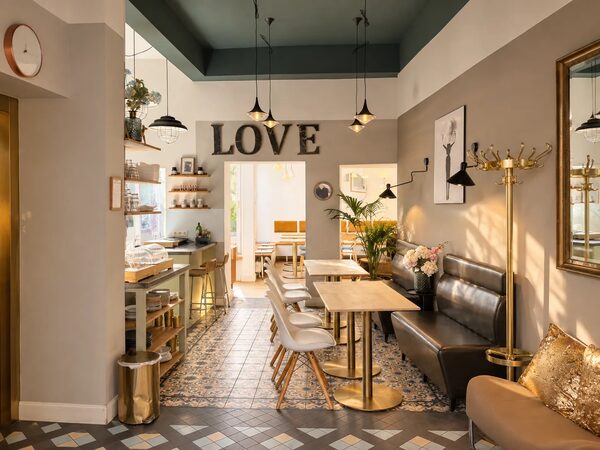
At this point we'd like very much to add: We could even put an end to one legend, that cocktails were served at marsil. But there really were naked people dancing in the fireplace room. Just a little information for all of you who love new legends and like to share them. We appreciate any photos you can send us to hotel@marsil.de – if they are intended for our friend Michael we will, of course, forward them.
The Wolfgang Hahn Prize Exhibition at the Museum Ludwig runs until the end of August. Further infos und work by the jack-of-all-trades Michael Krebber can be obtained directly from Galerie Buchholz. The marsil is located Cologne's Hahnenviertel district. Please submit inquiries via the website marsil.de.