... what happens when the visions we have relied on no longer hold up? When progress appears less like a promise and more like an abyss? The group exhibition FUTUR seeks the future not merely in new images, but in the relationships generated by our present—between people, institutions, technologies, and the environment.
In collaboration with the Paris-based collective Le Wonder, the exhibition brings together artistic positions that do not predict the future, but rather examine the ways in which we perceive it. Shaping the future together seems impossible. Yet, through the work of Fred Moten, we find ourselves connected to a space of thought founded on the very fact that it excludes us. Or, as participating artist Samir Laghouati-Rashwan asks: "Do you think ghosts care about what we think of them?"
The Paris-based collective Le Wonder is one of the most renowned and influential artist-run collectives in France. Since its founding in 2013, the collective has occupied and revitalized vast, disused industrial complexes in the Paris suburbs (*banlieues*), creating affordable workspaces, studios, and creative incubators.
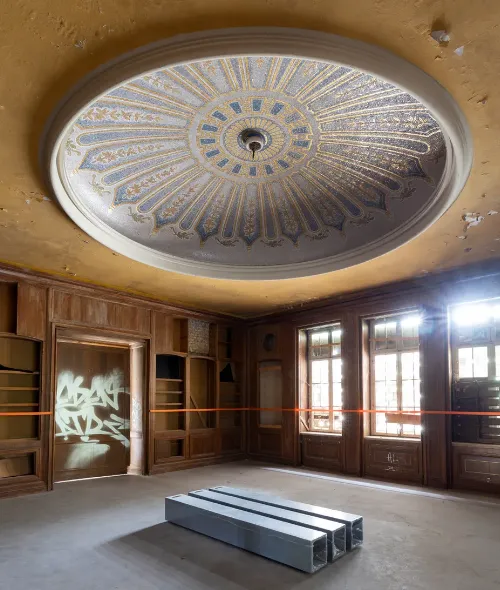
Presented as an artist-organized exhibition within a space otherwise closed to the public, Samir Laghouati-Rashwan’s work "Are you afraid of ghosts?" serves as a commentary on visibility and participation—privileges not equally accessible to everyone. A shared future cannot be conceived without considering whose experiences become public, which bodies are deemed to belong, and who has a say in shaping a society’s imagery.
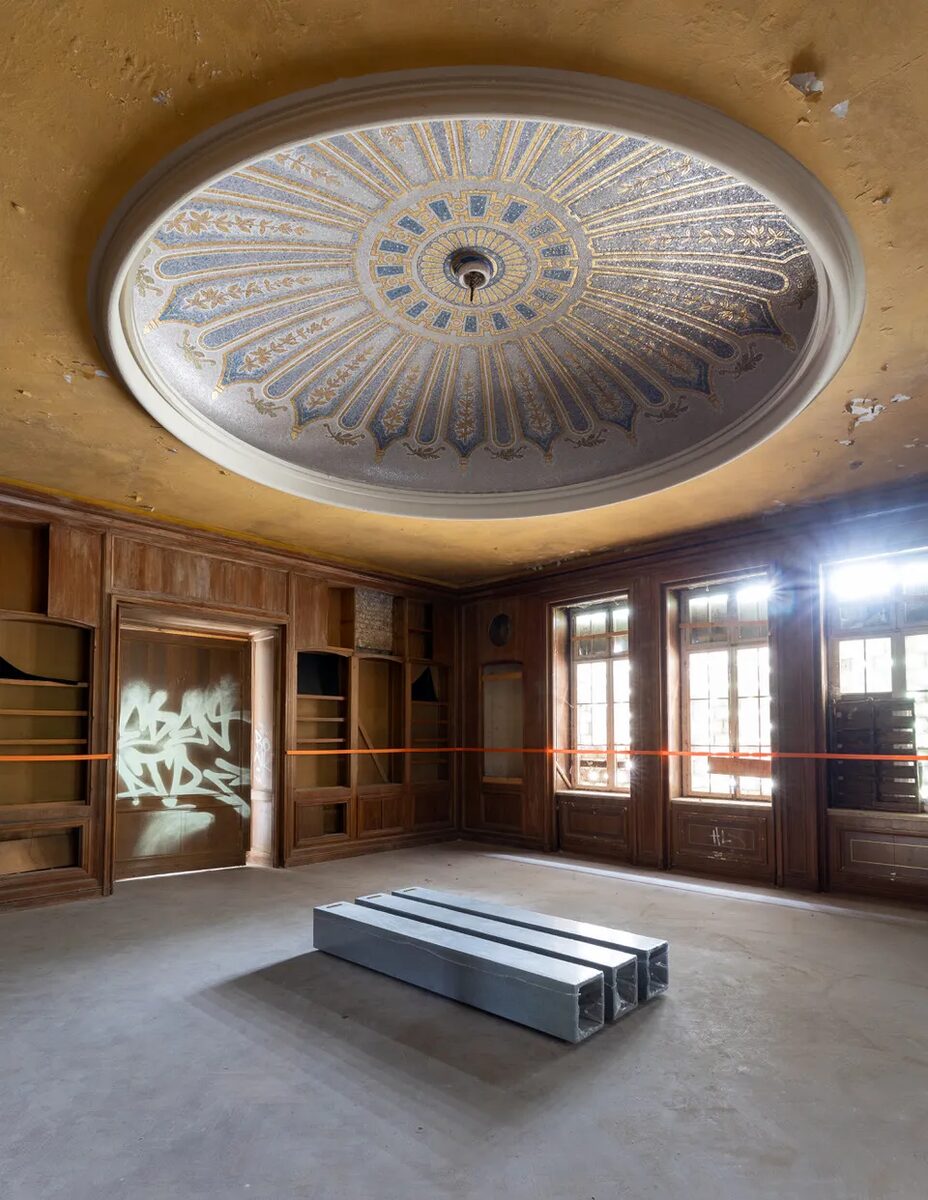
This historic site—often used as a film set—evokes questions regarding order, belonging, hierarchies, and the distribution of power. FUTUR opens the space to artistic experimentation, conflicting perspectives, and the question of how community can emerge when established rules lose their validity. A site with a military past is transformed into a laboratory for aesthetic and social possibilities. The exhibition navigates the terrain between urban infrastructures, performative protest ecologies, post-industrial idylls, and immersive media installations. It does not view the future as a distant scenario detached from the present; rather, it seeks traces of the future within existing spaces, bodies, technologies, and images. What we deem possible tomorrow depends on today.
Mischa Leinkauf’s artistic practice makes the rules governing public spaces visible by physically and spatially testing their boundaries. What appears to be a fixed function transforms into a matter of access, agency, and appropriation. For *FUTUR*, this reveals a political dimension of the future: change begins where seemingly immutable orders are reinterpreted.
In the work of Laurent Grasso, the boundary between observation and speculation becomes fluid. Mythological references meet familiar imagery, exploring the "now" as a transitional phenomenon. Within the exhibition’s context, this raises questions about the power of visions of the future: what expectations do they generate, what fears do they trigger, and what realities do they obscure?
Anne Posselt expands this inquiry to address the construction of reality. From this perspective, the future appears as something that is actively tested—and is therefore inseparable from the conditions of its own production.
With her machine *Kontrollaufgabe drei* (Control Task Three), Jenny Alten examines the point at which a system ceases to be controllable. Confronted with climate tipping points, the monstrosity of complexity causes us to dissociate. The onset of menstruation or labor, or the moment of ejaculation, occurs seemingly at random; she contrasts this bodily experience with a diffuse sense of unease within the exhibition space.
Finja Sander’s work raises questions regarding how we engage with space, time, and social norms. Presence and duration take on a distinct weight: change competes with stasis—not merely as an idea, but as a physical experience. Octave Courtin’s more-than-human sound objects engage with a different form of such experience. His animal-like creatures, drawing on steampunk aesthetics, make tangible certain spatial relationships that cannot be reduced to an image. In this way, the question of what the future sounds and feels like acquires a concrete aesthetic dimension.
The exhibition moves beyond the creation of images—addressing the very conditions of our perception.
Udo Koloska’s “Disko” makes the conditions of modernity visible. Global food trade, life in metropolitan areas, and digital media would be inconceivable without cooling technologies; these technologies are part of the colonial equation linking the Global South and North—a nexus of global warming, resource consumption, and survival. The “bourgeois coldness” described by Adorno and Horkheimer takes on a literal, material dimension in this installation; the blinking lights of refrigerators transmit signals from the future in Morse code.
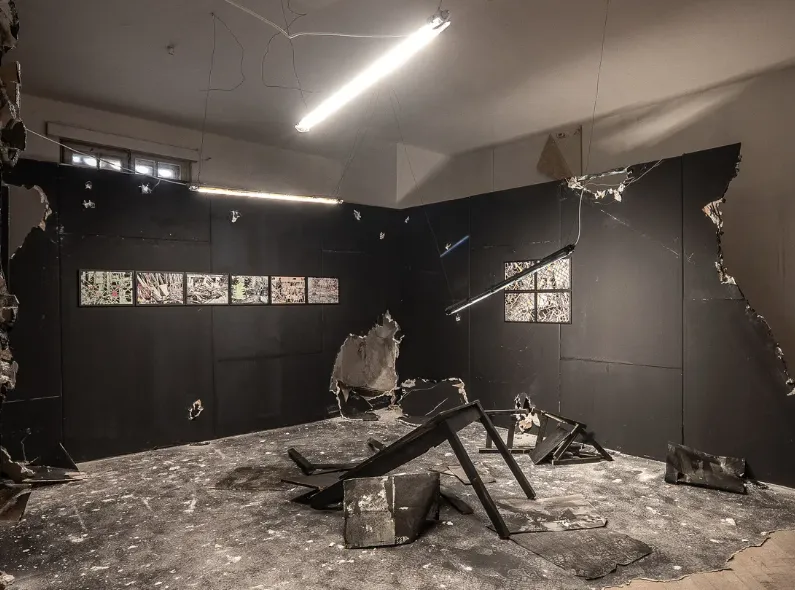
Phillip Langer’s “Black Box” traces the absence of hope for renewal, the state of standstill, and the quietude—as well as the restlessness—inherent in that state. The constant imminence of the end renders it elusive. A documentary-style approach to internal overwhelm and one’s own privileges exposes an inability to either allow for closeness or establish distance. The compromised shell of the space deprives the viewer of a safe retreat; its permeability becomes both a threat and a prerequisite for perceiving the looming end in the first place.
In *FUTUR*, these perspectives do not merely coexist in isolation. Through their interplay with other participating artistic positions, they form an open context in which urban structures, ecological issues, and spaces of media-based experience are brought into relation with one another.
The collaboration with LeWonder also highlights the collective dimension of artistic work. Here, togetherness does not mean dissolving differences, but rather giving them space and enabling new connections to emerge.
Thus, *FUTUR* articulates neither a utopia nor a narrative of doom. The exhibition invites us to view uncertainty as a starting point for attentiveness and action. Its perspective on leave-taking and transformation is radical, at times playful, and always open to the unpredictable. Much like in roulette—just before the ball drops—a moment intensifies in which many possibilities seem within reach. Yet, unlike in gambling, the question remains not only what the future might look like, but under what conditions it unfolds, what relationships we enter into, and which rules of the game we alter.
Featuring works by:
Jenny Alten
Octave Courtin
Pierre Gaignard
Martin Gnadt
Collectif Grapain
Laurent Grasso
Antonin Hako
Charlotte Janis
Udo Koloska
Samir Laghouati-Rashwan
Phillip Langer
Mischa Leinkauf
Anne Posselt
Finja Sander
Cécile Wesolowski
FUTUR – Finnische Allee 6, Potsdam. Exhibition dates: Oct 2–11, 2026. Artist-led tours: Tue–Thu 1–5 PM and Fri–Sun 11 AM–5 PM.
About half of the artists come from Bobigny (near Paris), Potsdam’s partner city; consequently, some tours will be conducted in English. Each tour lasts one hour.
Tours start every 15 minutes; admission is free, and time slots can be booked via Eventbrite.
SUPPORTED BY: Kulturland Brandenburg, State Capital Potsdam, Franco-German Citizens' Fund, Frac Île-de-France, Angelika Euchner with the support of ProPotsdam GmbH
GoSee : artifactpotsdam.de/futur + lewonder.com