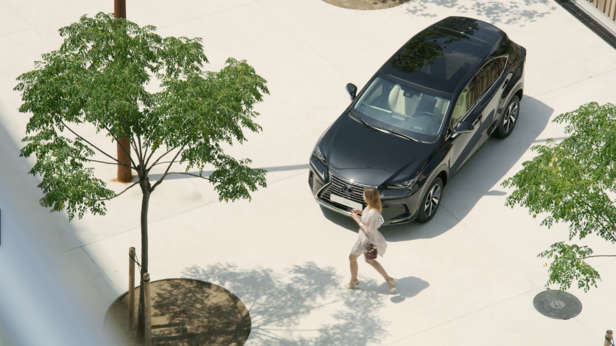
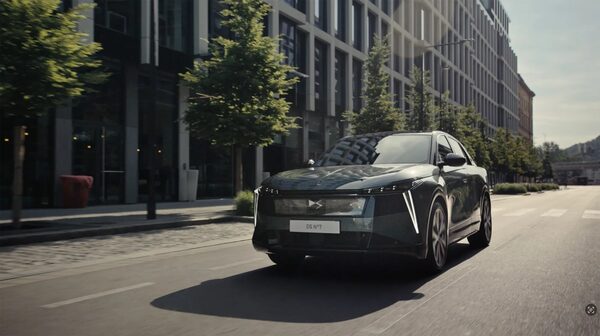
ViewmasterCGI once again commissioned Michael Schott and his team to work on the video and still post-production for the new Lexus NX. Daniel Hartz was sworn to secrecy during his film and still production in the studio in Brussels, with elaborate camera and lighting equipment, in order to create a new visual concept with high standards. The results are two videos, each 105 seconds long, which the team compiled from real footage and around 60% virtual 3D CG elements. Michael Schott told GoSee: ‘the biggest challenge for this production was the coordination of merging the filmed sequences with the virtual set design.’
The complete background and base design was digitally created in CG in line with the concept and expertly implemented by the specialist team around Michael Schott. A Moviebird crane with 3D remote head allowed for very precise and controlled camera work with particularly dynamic camera movements. The advantage was increased flexibility in terms of building the set as well as clean detail shots, which required only minimal stabilization in post-production.
All the scenes were perfectly illuminated at studio photography level. There were over 120kW lighting powers at play on set. The snaps were optimized for post-production during the planning stage, in advance of the shoot and the set design was adapted accordingly. The reflective surfaces of the new Lexus SUV required extreme care and a creative set design approach in this case. This was the only way to guarantee that every single take would later be suitable for camera tracking. Maximum quality was achieved by use of the RED Epic camera. The film was shot in 5K resolution at up to 60 frames per second.
Michael elaborated: ‘the team at ViewmasterCGI had to take a completely new approach during post-production in order to achieve the high standard and fulfil the objectives. With the help of advanced Nivdia GPU workstations, the entire 3D workflow could be achieved in house, without a cloud or external render farm. Sensitive design data was thus always optimally protected. Pure GPU rendering allowed for background editing in production quality and with only a few iterations. A full-length 32-bit workflow offered maximum flexibility in color correction and gamma adjustments between the digital RED material and CG footage. We used NUKE for the composition.’
We have Michael Schott to thank for the grading at the DaVinci Resolve station. And what is his conclusion? ‘Overall, you can describe this production as an example for smaller studios and budgets, with over a hundred sequences achieved with a small number of staff and in spite of the large proportion of about 60% CGI’.