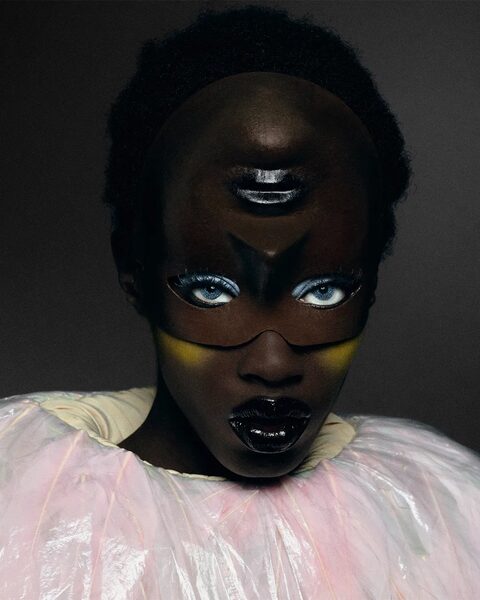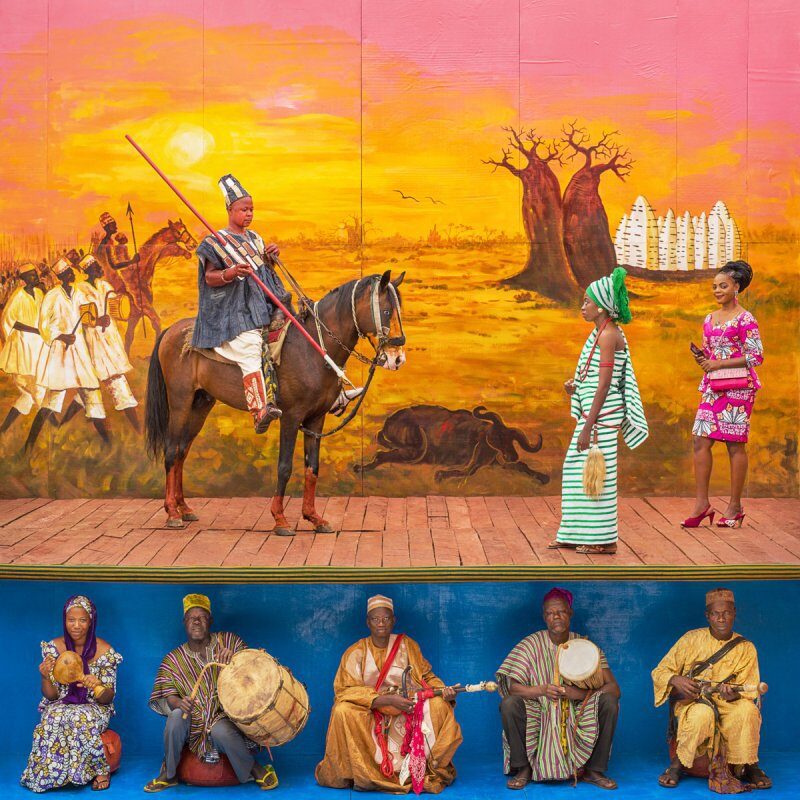
The colorful photos by French photographer Patrick Willocq are a must-see this fall. The series “You cannot pick a stone with one finger” was an Oskar Barnack Award Finalist 2017. It was produced with the Dagomba, an ethnic group in the north of Ghana where he created six decorative sets that reflect the past, present and future of the Dagomba. A local proverb says that, ‘one finger cannot pick a stone’, which means you have to stick together to move forward. The six scenes bear witness to this saying and to the Dagomba’s rich cultural heritage, and aim to help understand how history and traditions have shaped present-day realities and the challenges ahead.
“The biggest challenge for my type of photography is the building of the sets. Everything is built from scratch, using locally available materials. No Photoshop collage or montage. This takes much more time and requires more resources than conventional photography, but the end result is far more rewarding I think, if only for the human experience, as my approach is really about trying to decipher local culture and depict it visually in a way that is the most artistically appropriate. This requires building close relationships with people.
For this project, I interviewed the overlord King Yaa Naa, various paramount chiefs, court elders, musicians, university academicians, an Islamic scholar and a traditional land priest. Although Dagomba culture is heavily influenced by Islam, many also still believe in and worship traditional spirits and gods.Based on what these people told me, I developed six performative photographs. To ensure a culturally accurate visual iconography, local artists and artisans helped to build the large decorative sets, using locally sourced materials. On these stages, the protagonists were able to perform like actors,” says Patrick Willocq. The series is now on display in the LEICA Shop in Paris where there was also a book signing with the photographer, who published 'Songs of the Walés' this year at Kehrer Publishing.
For the Ekonda pygmies in the Democratic Republic of Congo, the most important event in the life of a woman is the birth of her first child. The young mother is called Walé. For several years after giving birth, she lives in semi-seclusion. When the time comes to reenter society, she puts on a show for the community, translating the lessons learned during seclusion into songs and dances. These celebrations captured the attention of French photographer Patrick Willocq, who, in a unique collaboration with some Walés, their respective clans, an ethnomusicologist, an artist and many artisans of the forest, constructed elaborate and surreal sets, inspired by the Ekonda mothers’ chant. With his work – appearing as a book at Kehrer Publishing – Patrick Willocq (* 1969) wants to show a different, more positive picture than the images of war in the region spread by the media.
Born in 1969, Willocq taught himself the craft of photography. He has spent the larger part of his life outside of France, and today he is at home in Paris, Hong Kong and Kinshasa. In 2014, Willocq was already a LOBA finalist with his ‘I am Walé Respect Me’ series. With his work, the photographer wants to show an image of Africa that goes deeper than the one the public media focusses on. ‘You cannot pick a stone with one finger’ is a commissioned work for the Noorderlicht Foundation and the African Studies Centre in Leiden, Netherlands.
http://www.leica-oskar-barnack-award.com/en/information/finalists-2017/patrick-willocq.html