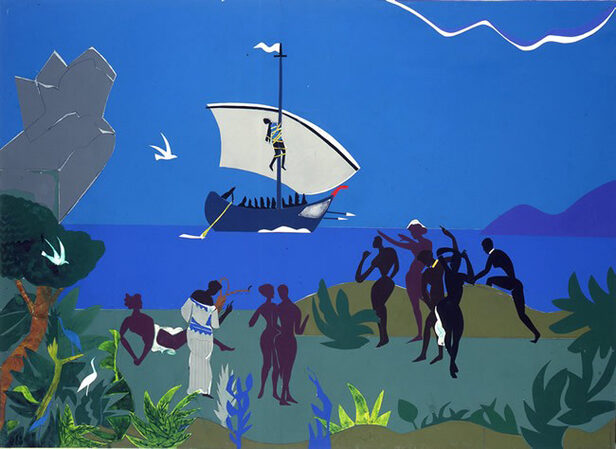
We met designer Somchit Sinthirath in the garden of Villa Noailles in Hyéres, where she was invited to give a workshop at the fashion festival on the fundamentals of fashion, the high art of the trade, and its 'savoir-faire'. "For this workshop especially created for the 30th anniversary of Hyères festival, I was inspired by the work of Romare Bearden, an African-American artist who reinterpreted in his paintings the odyssey of Ulysses," Somchit explained, while she closely observed her workshop participants taking their first steps. The object was to reenact scenes from the Odyssey with the 'draw and cut' technique, and apply them to silk chiffon tank tops.
Somchit herself is a seamstress in the third generation. When she was only 18 years old, she and her mother started their own business producing prototypes for all the large Paris couturiers. "The essence of my work can be described as being in love with technique, more exactly with the systematic study and development of it. In fact, the end effect being simplification, however, paradox as it may seem, even the simplest parts of my collection are based on a sophisticated technique, which is absolutely no contradiction."
At the age of 19, Somchit met designer Jean Colonna – which proved to be one of her most important encounters. "This was a decisive encounter for me which strongly influenced my career path. Up until then I had only worked for high-end fashion houses, where the techniques used are rigorous and very academic. I discovered Jean's creative universe as a kind of aesthetic shock. No "coutures anglaises", no handkerchief hems, but instead visible oversewing, raw edges, very free textile experiments. The compilation of all these elements resulted in a very young and trendy style which I easily imagined wearing. I therefore discovered a new way of viewing women's clothing and of creating a garment." 21 very inspiring years were to follow this initial encounter, which at the age of 22 lead to a visit of the Studio Bercot – parallel to her jobs for Jean Colonna and other fashion houses.
Over the years, the student became a very esteemed sewing teacher at the famous school Studio Bercot – as well as an enthusiastic fan of a technique called "origami tessellation". A sponsorship brought her to Thailand which was followed by the first presentation of her work, naturally titled "origami tessellation", on the side of Jean Colonna, who then offered her a collaboration "Somchit Sinthirath for Jean Colonna".
How did the workshop in Hyéres come about? It was Jean-Pierre Blanc, director of the festival, who invited me. We met a few weeks before for a different project – one thing led to another and the workshop for festival participants was created, children, adults, amateurs,… whoever wanted to take part.
Were there strict rules, or did you have a carte blanche?
No, I could organize the workshop anyway I liked, the only limit was time and, of course, the certainty that there would not be a uniform group of participants. Since it was the 30th festival, it was going to be something special, and everyone would take home a beautiful souvenir. And since we'd only have a short time, I had the idea with the tank top, which could be 'finalized' on site. The inspiration for came from the Afro-American artist Romare Bearden, who in 1977 created a collage spread on the subject 'the black Odyssey', in which he transported the Odyssey to the present day. I prepared the t-shirts, as well as the patterns for the collages, which allowed the participants to design their own scenes.
You have worked with nearly everyone in the industry, can you share some of that with us? When I was 18, my mother and I went into business with our 'Atelier de Prototypage'. Our customers were the big names of the even bigger fashion houses, as well as the hip, young designers that were absolutely in vogue. I had just graduated from school, and I had no idea about fashion as a business. All I knew was how to sew and all of the required techniques, and I was not really interested in anything else at the time.
One day, André Walker, a creator for whom we made the prototypes for the catwalk, came into our studio with his staff of about 15 friends and apprentices. In the afternoon, this very congenial boy came in, who brought food and drinks for everyone. The next day, André Walker was invited to appear in the show 'le grand journal' on the TV channel Canal+, and again the boy turned up at his side. I asked myself what he was doing – until a colleague filled me in: The 'boy' was Marc Jacobs, the new Art Director of Louis Vuitton. Why do I remember this story so well? I think perhaps because he was the very first star I had ever met, and because I was not really very familiar with the fashion scene.
Technique and craftsmanship seem to be in your blood. Is that still realistic at all in 2015? The "artisanat", or craftsmanship, has come upon hard times. In 2015, there are almost no couture studios, embroidery shops, button makers,... they are all on the verge of vanishing. That was completely different in Paris around ten or twenty years ago; many of them had to close due to lack of work. Globalization naturally also delocalized their work – and whether it is still realistic in 2015? I think so, we only have to reevaluate the entire process, that is, from production down to distribution.
Today, most businesses prefer a pyramid economic system, one that is built mostly on profit. Keeping old techniques and handcrafts alive is only secondary. So we can hardly count on them to do so… and therefore, designers and artists must think about how to preserve and nourish their crafts. Every year, countless young people are trained in these crafts, whereby the positions are extremely limited, because they only work for the upper luxury segment. Everyone else has to see how they can live off of what their hands make them and to capture the market own their own the best they can. A very hard task for an individual – and it is becoming more and more difficult because the ready-to-wear market is nearly saturated, and the costs of creating your own collection are increasing.
I think crowdfunding could be the most successful approach in this case. It's an idea that has been established successfully in many other areas. As a 'horizontal system', it allows the creatives to work together with mutual respect and on an equal basis for an individual clientel, with whom a work relationship can be slowly and carefully built. So for me, AADARZA is something like a prototype: If it works for us, then maybe other creatives might like to work together too.
What exactly is AADARZA all about? AADARZA artists' collective, who have made it their goal to redefine modern fashion. I had the idea while traveling through India and Asia. There, the fashion guilds have wonderful days ahead of them; you find fabric makers, tailors or seamstresses and milliners on every corner. In Paris, these occupations have nearly become extinct over the past ten years. In addition, those of us who persevere can only do so under working conditions that are now often precarious to say the least. This, of course, means we are losing great talents and unique crafts – and the project AADARZA is meant to raise awareness for this issue.
Where does the name AADARZA come from? AADARZA comes from Sanskrit and means 'pattern' and 'ideal'. If I were to use a French word with an equal meaning, I assume it would be 'un paradigme'. For me, the word AADARZA stands for the idea of a new fashion model, as well the validity of its principles and its methods for the collective artists or everyone involved. Today, fashion suffers from a lack of esteem for the creatives as well as for the craftsmen. And along with that, it offers less and less opportunity for creative development and hardly any perspectives. The wonderful thing about the word for me, is that it keeps reminding me, that nothing is final, but that everything can be changed.
And what is the concrete intention behind it? I can answer this question best with the manifesto of the Brücke Artists' Group formulated by painter Ernst Ludwig Kirchner, a German expressionist: "With faith in development and in a new generation of creatives and a new appreciation of art, we call together all youth; and as youth, upon which the future depends, we endeavor to obtain for ourselves creative freedom and the freedom to live over long-established older forces. Anyone who directly reproduces that unadulterated force which impels him to create belongs to us." For me, this perfectly sums up what AADARZA means (the manifesto of the bridge, written by Kirchner was presented on October 9th, 1906 in the Elbtal Evening Post. Kirchner created a woodcarving, on which he wrote the manifesto – translated). Approaches can be seen throughout the world; refer also to coworkingmanifesto.com.
What are your next projects? I am working on two projects at the moment: The first is "PARADIGME / Valoriser le savoir-faire par la création", and the second is a weekend workshop titled "MECENAT/ Transmettre le savoir-faire". Anyone who wants to learn more about it, please contact me.
About - SOMCHIT SINTHIRATH. Since her early childhood, her mother worked as a seamstress at home for various big fashion houses. Passionate about her profession, and having a real talent for "couture flou", there was no lack of work at home. Dior, Chanel, Paco Rabanne, Givenchy, Lacroix, Nina Ricci, Emmanuel Ungaro. Seeing so many of the big brands parading through her sitting room helped her learn the basics of this business. These were very formative years, where she learned all aspects of "couture flou" from her mother. Silk chiffon, crepe, satin, very fine cotton, velvet .... very quickly Somchit understand what a demanding profession this is, and that every last millimetre counts. She learned not only machine sewing, hand sewing, cutting, ironing, but also learn to think as a "mecanicienne modèle" whilst making their first prototype. From one season to another, the styles, material, and cuts change.
After 17 years experience, Somchit has worked on hundreds of different creative projects. She worked as a "mécanicienne modèle, première main" for Dior, Gallianno, Paco Rabanne, Nina Ricci, Guy Laroche… she worked closely with Jean Colonna for over 10 years, for whom she produced prototypes, created new textiles and worked on volumes. Somchit was "responsible d'atelier" for projects such as "The preparation for the Venise biennale closing ball, organised by the Hyères festival in 2006 under Jean Colonna's artistic direction".
Somchit worked as the head of a company producing prototypes from 2008 until 2012 where she worked for Givenchy, Rue du Mail, Lutz, Jean Colonna, Abraham Pelham, Nouvelle Affaire… she also worked on uniform projets (Meurice, Piaget, Swarowsky, L'Oréal, La Prairie, la Maison de l'Emir du Qatar), advertising (Evian, Armani, Victor & Rolf, Givenchy, ING Direct) as well as photographic projects (Héroïnes de Bettina Rheims) and high end bespoke projects for private clients.