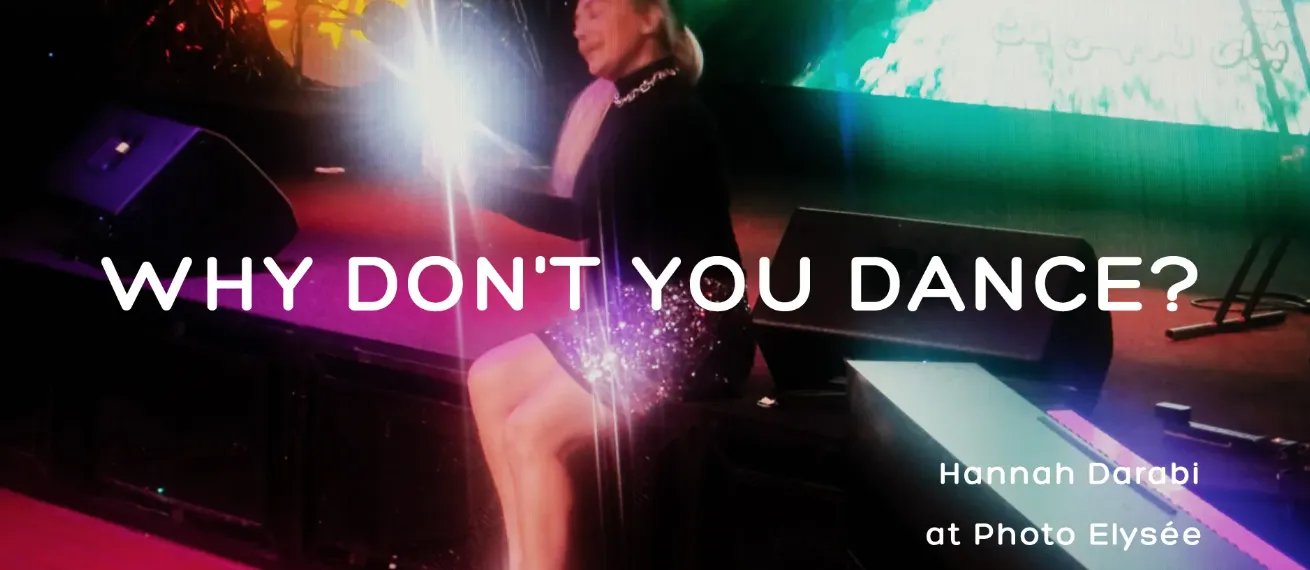
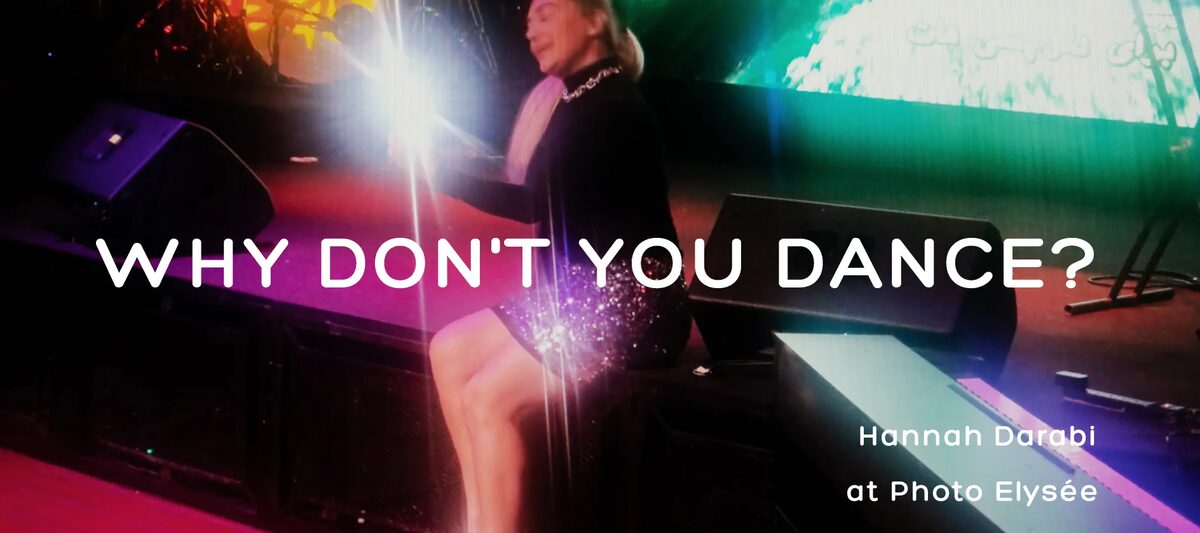
As the winner of the 2025 Prix Elysée, awarded by an international jury of experts, Hannah Darabi (1981), an Iranian artist based in Paris, explores Iranian folk dance as an act of identity resistance through photographs, videos, and archives interwoven with the social and political history of her homeland.
She creates series in which her images enter into dialogue with archives, texts, and objects, revealing the political complexities of contemporary Iran.
Inspired by Woman, Life, Freedom—a recent nationwide protest movement against the restrictive laws imposed on women by the Iranian government—her project, "Why Don't You Dance?", revolves around three iconic figures of Iranian folk dance. Each figure is part of the exhibition, initiating a dialogue between themselves, between past and present, and between Iran and the diaspora.
Mahvash, one of the first cabaret singers and dancers of the 1950s, forms the foundation of this project: Her fictional autobiography allows Hannah Darabi to explore how dance functioned as a tool of protest during the 1979 revolution and how women's bodies—both in expression and appearance—were increasingly subjugated. In a series of collages, Darabi reinterprets her seminal book, *The Secrets of Sexual Fulfillment* (1957), which combines magazine pages, text excerpts, ephemera, and her own photographs.
Jamileh, known for her mastery of belly dance and the "Jaheli dance"—a popular form rooted in Iranian urban environments—embodies the tension between tradition and modernity. This interplay of blurring temporalities is staged in a series of three videos, for which Darabi collaborated with a collective of dancers and choreographers in Berlin.
The third central figure in Why Don't You Dance? is Mohammad Khordadjan, a dancer and choreographer in the Iranian pop scene in Los Angeles. Through him, Hannah Darabi opens a window onto the diaspora and the practices developed in exile by showcasing evenings at the legendary Tehran Cabaret, a must-see for Iranians in Southern California.
Through these three figures, Darabi explores how dance has accompanied the transformation of Iranian society from a traditional understanding of gender to a modernist discourse. The project thus transforms entertainment into a political act, the archive into a tool of resistance, and artistic performance into joyful defiance.
Hannah Darabi (IR, 1981) is a Tehran-born artist who studied at the École supérieure des Beaux-Arts before continuing her studies at Paris VIII-Vincennes Saint-Denis University. Today she lives in Paris and dedicates the majority of her artistic work to her country of origin, exploring its social, cultural, and political themes through images, videos, and archives.
In 2022, she received the Bernd and Hilla Becher Patronage Prize from the city of Düsseldorf for her complete body of work, as well as the Madame Figaro Prize for her exhibition at the Rencontres d'Arles in 2023.
Her books and artworks are held in numerous public and private collections. Her book, 'Rue Enghelab, la Révolution par les livres: Iran 1979–1983', published in 2019 by Spector Books and Le Bal, received several awards. In 2021, the GwinZegal Art Center published 'Soleil of Persian Square', a research and creation project dedicated to the Iranian diaspora in Southern California and its popular music.
Awarded every two years and endowed with a prize of 80,000 Swiss francs, the Swiss Prix Elysée recognizes a photographer in the mid-career stage for the realization of an original project. It perfectly aligns with Photo Elysée's mission to support contemporary work and accompany artists during a pivotal phase of their careers.
Since its inception in 2014, the Elysée Prize has been awarded to Hannah Darabi (2025), Debi Cornwall (2023), Kurt Tong (2021), Luis Carlos Tovar (2019), Matthias Bruggmann (2017), and Martin Kollár (2015). The Prix Elysée is the result of an exclusive partnership between Photo Elysée and Parmigiani Fleurier.
"Why Don't You Dance? by Hannah Darabi unfolds amidst instability: turbulent news, an uncertain future, censorship, and self-censorship. In a context of recurring uprisings and escalating conflicts, Hannah Darabi pursues the method of an artist-researcher: she collects, reads, and arranges photographs, archives, song lyrics, and popular music to create a critical narrative at the intersection of art and research.
The project weaves an emotional geography between Tehran and Los Angeles, where portraits from the Tehran Cabaret play a shared role. The book moves through three sentences—Mahvash, Jamileh, and Mohammad Khordadjan—that respond to one another and structure the reading. The artist shows how dance, depending on place and time, becomes entertainment, an affirmation of identity, and then civil disobedience.
Driven by the "Woman, Life, Freedom" movement, women and bodies express themselves differently: responding with joy becomes a political strategy. Dance connects the diaspora: here, inner Views and perspectives from exile; when speaking about Iran from elsewhere, the resonance of the past in the present, which runs through the images, becomes tangible.
At Photo Elysée, we are defending precisely this with the Prix Elysée: a photograph that documents the present with rigor and commitment and acknowledges the political power of the book. "Why Don't You Dance?" offers a tangible demonstration of this: a narrative of the present." - Nathalie Herschdorfer, Director of Photo Elysée, Lausanne.
Catalogue: Hannah Darabi - Why Don't You Dance? . Publisher: Kodoji Press & Photo Elysée . Author: Hannah Darabi . Dimensions: 20.5 × 27 cm . Number of pages: 204 . ISBN 978-3-03747-131-9 . Price: CHF 38.- . Order from: shop.elyseemudac@plateforme10.ch
Photo Elysée Place de la Gare 17 CH-1003 Lausanne
GoSee : elysee.ch