Am Donnerstag Abend wurde im Berliner E-Werk in Anwesenheit von rund 300 Medienvertreterinnen und -vertretern der erste Anja-Niedringhaus-Preis für mutigen Fotojournalismus verliehen. Christiane Amanpour, CNN-Chefkorrespondentin, und die ZDF-Journalistin Barbara Hahlweg verliehen den mit 20.000 US-Dollar dotierten Preis an die in Jerusalem lebende Fotojournalistin Heidi Levine. Der Preis soll das Leben und die Arbeit der 2014 in Afghanistan ums Leben gekommenen Pulitzer-Preisträgerin und AP-Fotografin Anja Niedringhaus (1965-2014) würdigen. Ins Leben gerufen wurde die Auszeichnung im Jahr 2014 von der International Women’s Media Foundation (IWMF) mit Sitz in Washington DC. Die Non-Profit-Organisation setzt sich weltweit für Journalistinnen ein und bestärkt sie in ihrer Arbeit als Berichterstatterinnen.
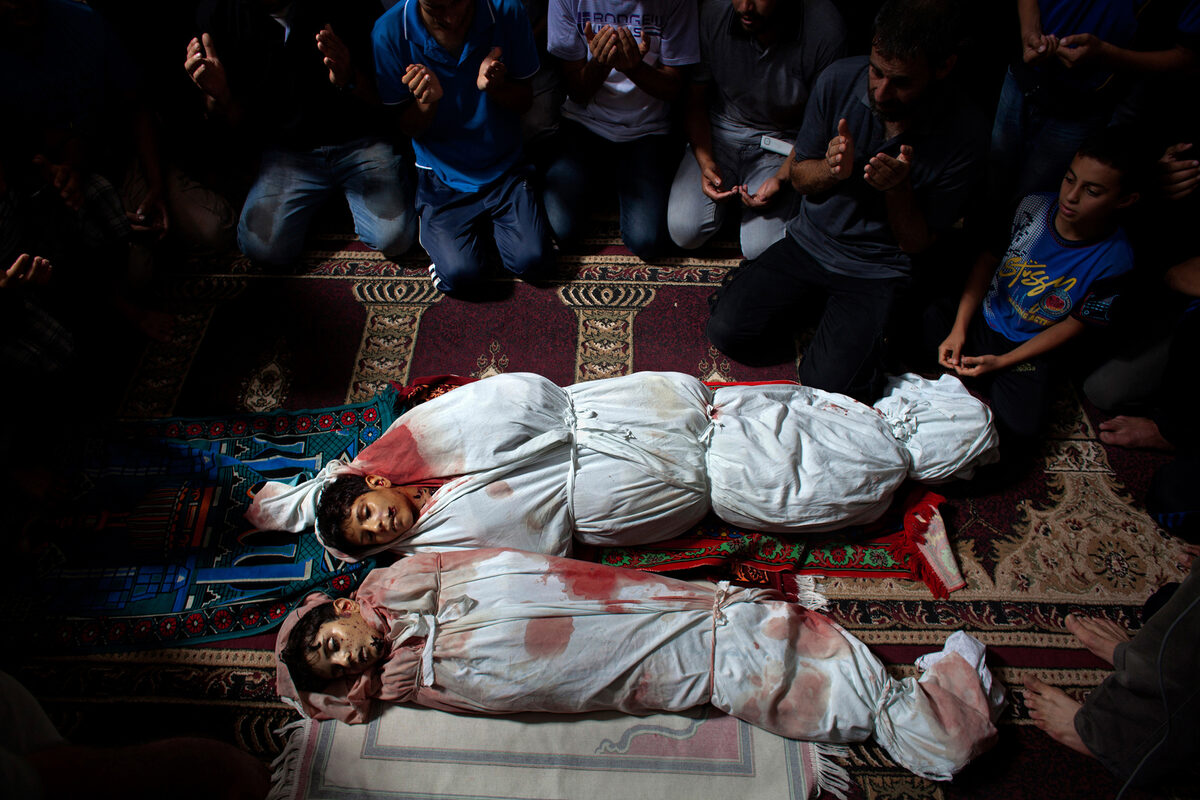
Ausgezeichnet wurde Heidi Levine für sechs Fotos, die sie im Gaza-Krieg 2014 aufgenommen hatte. „Ich möchte zunächst Anjas Familie danken, die am meisten gelitten hat“, sagte die Gewinnerin Heidi Levine. „Vor meinen Kolleginnen und Kollegen, die während ihrer Berichterstattung in Kriegen verwundet und getötet wurden, habe ich größten Respekt. Journalisten geraten zunehmend selbst in die Schusslinie. Deshalb müssen wir stark bleiben, entschlossen und frei, damit diejenigen, die leiden, nicht verstummen und von der Welt vergessen werden.“
Während der Preisverleihung wurde der Mut von Fotojournalistinnen gewürdigt. Sie riskieren immer wieder ihr Leben, um Konflikte und Kriege zu dokumentieren und Momente der Menschlichkeit festzuhalten.
Heidi Levine is an American freelance photojournalist based in Jerusalem. She has worked as a professional photojournalist since 1983, starting as a staffer with the Associated Press in Israel, then with French photo agency Sipa Press in 1993. Over the course of her photojournalism career, Levine has covered the most critical moments in the Middle East including the revolutions in Egypt and Libya, the crisis in Syria, the Israel-Lebanon war, and the numerous conflicts in the Gaza Strip.
“Living in the region and raising her three children, Heidi Levine experiences the story on both a professional and very personal level, facing the same dangers as her subjects in a war zone, with rocket fire and air strikes a consistent reminder. Unlike many journalists who can cover a story and get on a plane to the safety of their own homeland, she is an integral part of the community and has shown profound concern for people, even moving her Palestinian assistant days before their home was reduced to rubble and putting down the camera to hug an anguished mother. Her passion for bearing witness over three decades is evident, even as her heart endures the loss of friends and colleagues to the conflicts.” — Award Jury
Her other assignments have included documenting the harrowing practice of female feticide in India for the Sunday Times Magazine, the plight of Iraqi refugees living in Jordan, Syria and Sweden and the present exodus of refugees fleeing from war-torn Syria. In 2003, she covered the U.S. invasion in Iraq and in 2006, she embedded with U.S. troops, focusing on the lives of female soldiers. She has also worked in Afghanistan and Georgia.
Levine’s photographs have appeared in numerous international publications, including Time, Stern, Focus, The Sunday Times Magazine, Paris Match, L’Express, Newsweek, Forbes Magazine, The New York Times Magazine, and Amnesty International.
She has won a myriad of awards for her photographs of conflicts, among them the Silver Award in the video/multimedia feature category at the Canadian Online Publishing Awards, an honorable mention at NPPA’s Best of Photojournalism for the International News Picture Story, and an Emmy nomination in 2012.
Levine holds an MA in Photojournalism and Documentary Photography from the London College of Communication.
About - Anja Niedringhaus (1965-2014) began full-time work as a photojournalist in 1990 when she joined the European Pressphoto Agency (EPA) in Frankfurt, Germany. One of her first assignments for EPA was covering the conflict in the Balkans, where journalists were regularly targeted by Bosnian Serb forces. On her first day in Sarajevo, Niedringhaus was hit in her flak jacket by a sniper’s bullet. She stayed in the region for ten years, covering Albania, Bosnia, Croatia, Kosovo, Macedonia and Serbia and exposing herself to the dangers of civil war.
In 1997, her foot was crushed and broken in three places by a police car while she was covering demonstrations in Belgrade, requiring three reconstructive operations. That same year, Niedringhaus became EPA’s chief photographer. In Kosovo in 1998, Niedringhaus was blown out of a car by a grenade while caught in cross-fire. In 1999, in Albania, she was with a group of other journalists at the Albania-Kosovo border crossing when they were mistakenly bombed by NATO forces. Niedringhaus says that she and her colleagues tried to hide in bunkers and cars as the NATO forces continued to fire. The bombing went on for 20 minutes, until NATO got word of their mistake. Some of the journalists’ cars were destroyed and a few of the other journalists in the group were injured.
In 2001, Niedringhaus photographed the aftermath of September 11 in New York City for the EPA. Shortly after that, she traveled to Mazar-e-Sharif and Kabul, where she spent three months covering the fall of the Taliban in Afghanistan.
In November 2002, Niedringhaus moved to the Associated Press as a traveling photographer. Much of her work since then has taken her to the Middle East, where she has reported on events in the Gaza Strip, Israel, Kuwait and Turkey. Once the war in Iraq began, Niedringhaus traveled to that country, which is considered one of the most dangerous places in the world in which a journalist can work. According to the International Press Institute, 23 journalists were killed in Iraq in 2004. In November 2004, Niedringhaus was embedded with the U.S. Marines during the U.S.-led offensive into Fallujah. She also photographed the bombings of the Red Cross headquarters in Baghdad and the Italian base in Nasiriyah, as well as events at the Abu Ghraib prison and the 2005 Iraqi elections.
Anja Niedringhaus also covered the G-8 Summit in Geneva, the terrorist bombings in Madrid and the 2004 Olympic Games in Athens for the AP. She was the only woman on a team of 11 AP photographers awarded the 2005 Pulitzer Prize for breaking news photography. She was born on October 12, 1965, in Hoexter, Germany. She died on April 4, 2014, when an Afghan policeman opened fire while she was sitting in a car with AP reporter Kathy Gannon in eastern Afghanistan. Anja Niedringhaus is the first Courage in Journalism Award winner from Germany. Read also : iwmf.org/reporting-from-the-front-lines-of-war