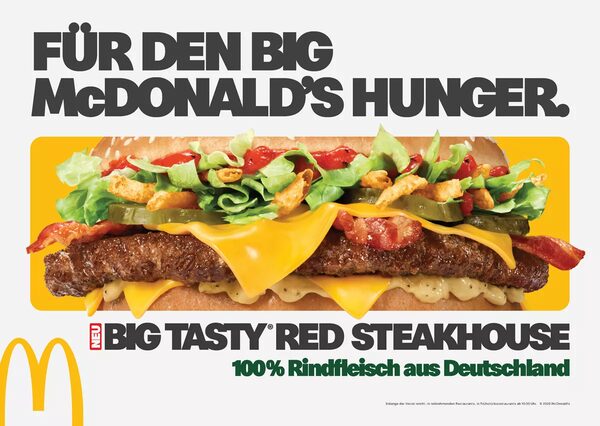
Since the beginning of the year, the new Studio Hackenberg in Hamburg has been running at full speed. A significant part of that momentum comes from the ongoing productions for McDonald’s, created together with Scholz & Friends. From burgers, wraps and fries to drinks, ice cream and non-food items, the resulting imagery can currently be seen across billboards, campaigns and numerous other media.
What ultimately needs to look effortless, casual and, above all, appetizing is actually the result of highly precise processes. For Calle Hackenberg, food photography doesn’t begin with the camera and lighting. Food styling, set, post-production and client coordination all have to work seamlessly together – and sometimes it is the breadcrumbs next to a sandwich or the traces of butter left on a knife that transform a perfect product shot into a credible and appetizing food image.
The new studio has long since become more than simply a place to shoot. Production, an extensive archive of props and equipment, food styling, dedicated client areas and post-production are so closely integrated that the first finished files can sometimes be delivered while the shoot is still underway.
gosee.news spoke with Calle Hackenberg about why the perfect amount of disorder is essential to a great food photograph, why everyone has a different idea of what the perfect apple looks like – and how workflows developed for McDonald’s can be transferred to other food, still-life and advertising productions.
Calle, at its best, food photography looks completely effortless and appetizing – yet there is an enormous amount of precision behind it. What is the secret to a truly great food image for you, and what perhaps distinguishes your approach from others?
First and foremost, a good food image always needs to feel approachable and deliver maximum taste appeal. It has to draw the viewer in and literally make their mouth water. The real challenge is finding the perfect balance between order, idealization and, above all, a certain casualness. The breadcrumbs next to the sandwich and the traces of butter left on the knife are what make the image truly appetizing and relatable. Without that fine balance of staged disorder and deliberate casualness, any food or dish simply ends up looking sterile and boring.
Of course, a great deal of precision and technique is involved behind the scenes as well: finding the right lighting for each product and for the different types of textures that food brings with it. To me, that is a given and should never take center stage. The same goes for being able to judge at any moment what needs to be solved photographically, what should be handled through food styling and what is better dealt with in post-production. Having a good 15 years of experience in food photography certainly helps – from small magazines and retail brands to major campaigns and the food wholesale sector.
My approach, boiled down to its essence, is always to focus completely on the product, understand the background and identity of the brand, and then find a way to express that visually. Only then do I bring the individual elements together and work closely with a food stylist to determine how we are going to create the image.
Open and straightforward communication between my team, food styling and the client is absolutely crucial. With food in particular, clear communication is extremely important because everyone has a different image of the perfect apple in their head. Bringing those different ideas together, extracting their essence and translating them into a consistent visual language is what my work is about – finding the right balance between high-class food imagery and an approachable sense of casualness.
You have been working in the new Studio Hackenberg since the beginning of the year. What can you achieve there today that was previously more difficult or perhaps not possible at all? Has the new studio also changed your workflow?
Beyond the advantages Hamburg offers as a location – with its entire infrastructure of people, technology and short distances – the main advantage is that we can operate extremely well as a one-stop shop for our clients and productions.
We now have everything in-house that we would need to lock ourselves away for four weeks and simply concentrate on producing. We have every kind of bowl and pot, extensive refrigeration facilities, hundreds of wooden boards and surfaces, and equipment stacked almost to the ceiling. Clients can retreat to a separate conference room, while there are also open workstations if post-production needs to happen on the fly alongside the shoot.
With this structure, we can produce a first finished version for many productions within 24 hours – sometimes literally overnight. You leave the studio in the evening, come back the next morning and can immediately discuss the first round of corrections. That's a level of efficiency we've developed here through a carefully coordinated workflow. Overall, the new studio has made all the distances even shorter and sharpened every process. We had the opportunity to design many things specifically around our own requirements. That not only creates better processes but also a space where people genuinely enjoy spending time.
It was important to me to create a place where everyone enjoys coming to work and finds the ideal conditions for their particular area. Nothing should distract from the production. For the duration of a project, everyone involved should function as one cohesive unit – and the studio helps enormously with that.
Many of the processes you have developed for the ongoing McDonald’s productions with Scholz & Friends should also be interesting for other clients. Which of these workflows or capabilities can be transferred to other food, still-life or advertising productions – and what kinds of projects is the studio particularly suited to?
Ultimately, almost everything can be transferred. Through our work with Scholz & Friends and McDonald’s – from ice cream, burgers, wraps and fries to drinks and non-food items – we have worked across virtually every product category. That means we are now more than confident with pretty much every discipline and product type.
The detailed processes running in the background allow us to deliver the first finished files on the fly while we're already working on the next product. That's valuable for any client dealing with complex approval processes or time pressure. It gives you an advantage in a working environment where every additional loop costs money and every loop is expected to become faster.
Beyond the processes themselves, one thing is particularly important: we're flexible and we find workable solutions, whatever the problem may be. That's something we've developed over the years. At the end of the day, things simply need to run smoothly – nobody needs to know about the obstacles we had to overcome along the way.
Studio Hackenberg is represented by the Hamburg agency DOUBLE T.